For most families, the most stressful part of teen driving does not begin with the first lesson. It begins after the teen starts driving with more independence. That is when parents often feel the real weight of the transition. The road test may be done, the instruction requirements may be complete, and the legal milestone may be in sight or already passed, but the first months still feel uncertain. Parents know their teen is no longer starting from zero, yet their experience is still limited. That is why the earliest period of independent driving matters so much. It is the point where basic skill meets real-world pressure, and where family rules, supervised practice, and judgment become especially important.
Why the Earliest Driving Period Carries More Risk
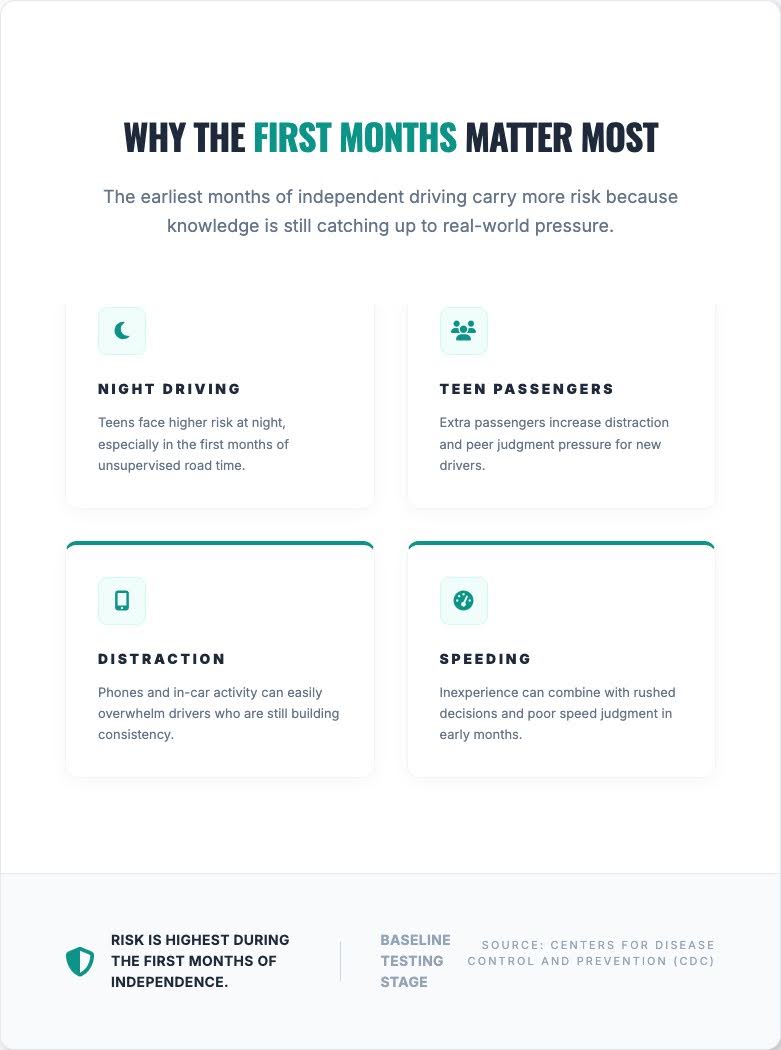
Teen driving risk is not evenly spread across the first several years on the road. It is the highest early on, when a young driver has enough knowledge to be behind the wheel but not enough experience to handle every situation with confidence and consistency. The CDC’s guidance on the main danger zones for teen drivers emphasizes that crash risk is especially high during the first months of unsupervised driving and that nighttime driving, teen passengers, distraction, and speeding all make that risk worse. For parents, those warnings usually feel less like theory and more like a description of exactly what they worry about most.
That early period can be deceptive because teens may appear ready in familiar settings. They may do well on routes they know, drive smoothly with a parent in the car, and follow instructions carefully during supervised practice. The challenge is that independent driving introduces a different kind of pressure. There is no immediate correction, no calm voice from the passenger seat, and no adult to help scan for risk when the situation changes quickly. That is why the first months matter so much. They are the stage when habits either strengthen or become more vulnerable to distraction, overconfidence, and poor judgment.
Why Parents Often Feel the Shift More Than Teens Do
Many teens view driving independence as a sign of progress, and in many ways it is. For parents, however, the emotional experience is often more complex. They are watching a teen move into a situation where mistakes carry real consequences, and they know that confidence does not always mean readiness. This difference in perspective explains why parents often become more vigilant, not less, once a teen gets closer to driving alone. They are not simply reacting to fear. They are responding to the reality that the first independent months are where inexperience is tested most directly.
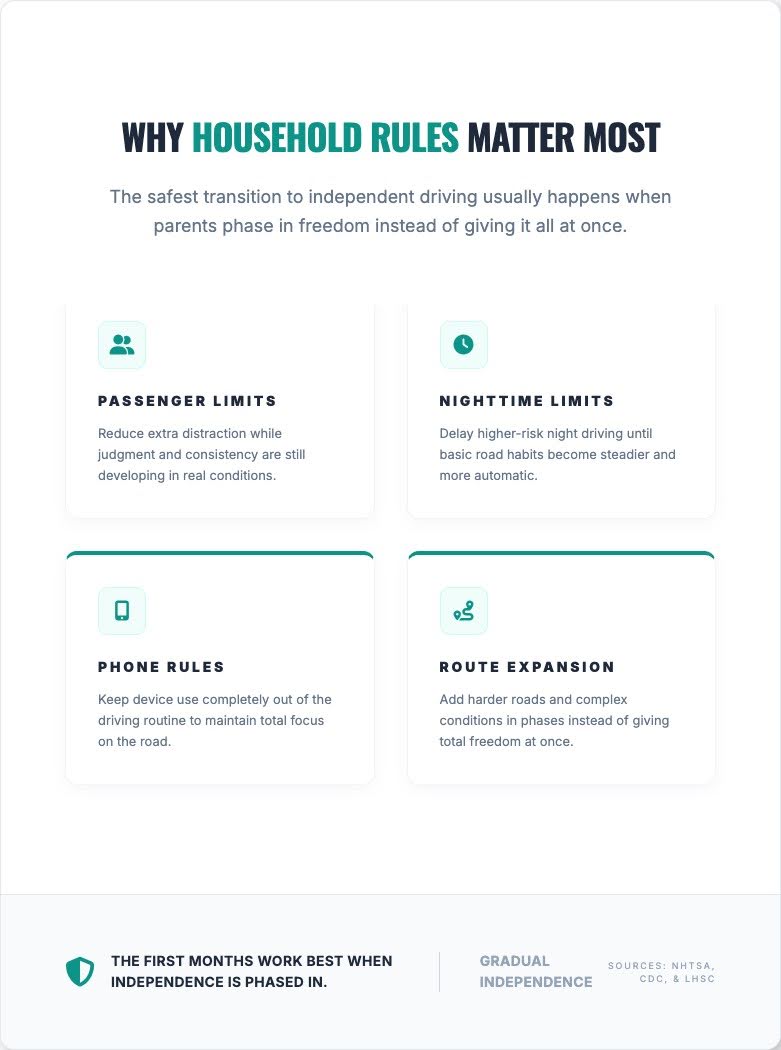
That is one reason household rules matter so much during this period. Curfews, passenger limits, route restrictions, and clear expectations about distractions are not signs that parents lack trust. They are practical tools for narrowing risk while the teen is still building judgment. In many families, the first months work best when independence is phased in rather than handed over all at once.
What Baton Rouge Families Are Thinking About
A recent Baton Rouge-focused article, “Why Teen Driver Readiness Is Becoming a Bigger Parent Concern in Baton Rouge,” framed this issue in terms of readiness rather than simple qualification. Its central point was that local families are looking beyond whether a teen completed the required process and asking whether the teen is truly prepared for real traffic, distractions, and everyday road conditions. That local framing matters because it reflects the exact stage where concern tends to rise. The first months are when parents begin testing what readiness really means outside the structure of lessons and supervised practice.
In Baton Rouge, those concerns can feel especially concrete. Parents are thinking about busy arterial roads, school traffic, weather changes, turning across active lanes, and how a teen will respond when another driver behaves unpredictably. The issue is not whether the teen learned the rules. It is whether the teen can apply them when the road becomes fast, crowded, or stressful. That is the question that shapes so much parental concern in the months immediately following formal instruction.
Why Practice Should Continue After the Milestone
One of the biggest mistakes families can make is treating the end of formal instruction as the end of meaningful practice. In reality, the first months are often when practice matters most. A teen who has basic instruction still benefits from repeated exposure to difficult but common conditions with a parent present. That may include nighttime routes, rain, parking situations, heavier traffic, merging, left turns, or unfamiliar destinations. The more these situations are rehearsed intentionally, the more likely the teen is to develop steadier responses when alone.
Continued practice also helps parents evaluate readiness more accurately. It becomes easier to see whether the teen is improving across conditions or only performing well in a narrow comfort zone. A young driver who remains calm in a variety of settings sends a different signal than one who becomes noticeably rattled when the environment changes. The first months are therefore not just a waiting period. They are a critical time for observation, coaching, and gradual expansion of independence.
Why Household Rules Matter More Than Teens Usually Expect
Parents often know that household rules are most useful when they are simple, consistent, and tied to real risks. That is especially true during the first months, when new drivers are more affected by distraction and inexperience. Clear rules about phone use, passengers, nighttime driving, and check-ins can make the difference between manageable independence and unnecessary exposure to higher-risk situations. These rules are not only about restriction. They are about pacing the transition so that a teen gains experience without taking on too many variables at once.
Many teens naturally want these restrictions to disappear quickly. Parents, however, are often right to keep them in place until their driving behavior starts to look more stable. A teen who can manage one passenger after dark with music playing is not always the same teen who performs best during daytime supervised practice. The first months are exactly when families need to be honest about that difference.
What Jeremy Watson Says Parents Should Watch Closely
Jeremy Watson, owner and lead instructor at Magnolia Driving Academy, says the first months of independent driving often reveal more about a teen’s readiness than the formal course itself. He points to consistency, calm decision-making, and the teen’s handling of normal yet unpredictable situations as the traits parents should watch most carefully. From his perspective, parents often benefit by looking for steadiness rather than perfection. The goal is not to see whether a teen never makes a mistake. It is to see whether the teen responds to ordinary challenges with growing maturity and control.
That perspective can help parents focus on the right things. The early months are not just about legal progress. They are about whether good habits hold under pressure. A teen who can recover calmly from a missed turn, who keeps scanning naturally, and who resists the urge to rush through traffic is showing stronger signs of readiness than one who simply feels excited to drive more often.
Structured Instruction Still Helps Families Start Stronger
Formal education still matters because it provides teens with a stronger foundation before they enter this higher-risk period. A structured course introduces the rules, supervised instruction, and skill development that make later practice more useful. For Baton Rouge families looking for that kind of beginning, a teen driver education program with supervised instruction can provide the early structure that helps parents and teens start from a stronger place.
But even strong instruction should be understood as preparation for the first real test, not the end of it. The early months of independent driving are when that preparation gets tested on real roads, under real pressure, and in real decision-making. That is why parents stay so involved even after a course is complete. They understand that the instruction matters most when it becomes part of a safer routine on the road.
Why the First Months Shape the Driving Habits That Follow
The habits formed during the earliest stage of independent driving can carry forward for years. This is one reason parents are often right to move slowly. A teen who begins with careful supervision, clear rules, and repeated practice in higher-risk situations is more likely to build safer patterns than one who is given broad independence before those habits are stable. The first months are not only a temporary stage. They are a period where driving behavior begins to settle into something more lasting.
That makes parental attention especially valuable. Families are not just reacting to short-term risk. They are helping shape the kind of driver the teen is becoming. In that sense, caution during the first months is not overprotection. It is a realistic response to a stage where the stakes are high and the learning curve is still steep.
Conclusion
The first months matter most in teen driving because that is when inexperience meets independence. It is the period when risk is highest, family rules matter most, and good habits need reinforcement before they can hold on their own. Parents know this instinctively, which is why so much of their concern rises after the basic milestones are met. For Baton Rouge families, the safest path is not to assume the transition is complete once the formal process is done. It is to treat the first months as the most important stage.